
A citizen science project to investigate fig wasp ecology.
This hands-on science experience gives Queensland primary and secondary school students the opportunity to contribute to vital research on these important insects.
All schools are invited to participate, with support provided to help students achieve success. All you need is:
- access to any species of fig trees
- a phone/camera to record the location and identifying features of your fig trees on iNaturalist
- plastic zip lock bags.
Participation is free of charge.
Upon registration, schools will receive:
- collection vials, pre-filled with preservative
- pre-paid return envelope to submit the samples collected to UQ for analysis
- access to microscopic-aided photographs of their wasps and genetic barcode data from the submissions tested.
Why the fig wasp?
Fig trees are prominent in our natural environments. They are a resource for countless organisms, from birds that feed and disperse their fruits, epiphytic plants, marsupials that take refuge in their crevices, thousands of invertebrates, and fungi and bacteria that are sustained by their roots.
Native Australian fig trees need tiny (~2 mm) fig wasps for successful pollination, and the wasps rely on the fig trees to complete their lifecycle. This relationship has evolved to the point where the tree and the wasp are completely dependent on each other.
These fig wasps are a keystone species in subtropical Australia. Without them, whole ecosystems we love and the species that rely on them are at threat.
Unfortunately, we still don’t even know how many species of pollinating and non-pollinating fig wasps there are, and how these relationships evolve and adapt to stresses such as climate change.

Proudly supported by the Queensland Government.
- Register your school
- Join iNaturalist
- Methodology
- Instructional video: Collecting figs for fig wasp citizen science
Register your school
Nominate a representative (e.g. teacher, club leader) to lead the project, and register your school to receive your collection vials and prepaid return mailer.
Join iNaturalist
We recommend that a teacher or Head of Department sets up a school-based iNaturalist account that can be used to lodge observations on behalf of participating students (this eliminates the need for students to create personal accounts):
Once you create an account, join the project:
Join Emerging Fig-ures on iNaturalist
If you need help, see:
- how to sign up for an iNaturalist account
- how to join an iNaturalist project
- how to make an observation on iNaturalist
- the iNaturalist Educators Guide
Methodology
- Explore your local area (either on or off school grounds) to find fig trees to monitor for the presence of ripening fruit.
Complete a CARA for school activity/excursion planning, if needed: Emerging Fig-ures CARA (PDF, 624.4 KB).
- Add the location of the fig trees to the Emerging Fig-ures project on iNaturalist.
Note: This provides a geolocation of each tree, and allows the citizen science community to identify the fig as much as possible from submitted photos.
- When possible and safe to do so, students should collect ripening fruit (a fig that's changed from green to a yellowish colour) and place it in a small plastic zip lock bag.
Note: Be sure to collect fruit that doesn’t already have holes in it. These holes are made by the male fig wasps and allow the female wasps — who can fly — to escape the fig and pollinate the next one. So, if the figs have holes they are unlikely to contain the wasps. See our instructional video on how to collect figs.
- After a few days, you should see tiny (~2 mm) wasps in the bag; place the bag in the refrigerator overnight to slow the wasps’ movements.
- Gently place the wasps and a sample of the fig into the preservative-filled vials provided and send them to us in the prepaid return mailer.
We will photograph the wasps using a microscope to aid morphological identification, and both the figs and wasps will undergo genetic sequencing to further aid in identification and mapping of relationships.
Participating schools will receive results from their samples to help students understand how these technologies are used to help scientists investigate ecological and evolutionary relationships.
Instructional video: Collecting figs for fig wasp citizen science
In this YouTube video, Associate Professor Anthony Young demonstrates how to collect figs in order to hatch out the wasps:
A range of resources about figs and fig wasps to engage students.
- Facts about figs and fig wasps
- Indigenous perspectives
- Kids' books
- Instructional video: Fig wasp bioinformatics session
About figs
Have you ever questioned why you’ve never seen flowers on a fig tree?
This PDF contains information on this unique plant: What's inside a fig? (PDF, 148.9 KB)
Identifying fig trees
 This PDF is a book chapter — taken from Peter Krisch's Rainforests of Australia's East Coast (2019) — with details of more than a dozen types of fig trees found in Queensland.
Download: Fig identification chapter (PDF, 1.6 MB)
Uploaded to this website with permission from the author.
Fig wasp lifecycles
This PDF contains information on fig wasp lifecycles: Fig wasp lifecycle (PDF, 1.4 MB)
A video excerpt about fig wasps — from the David Attenborough series A Perfect Planet [S01 E02 "The Sun"] — is available on ClickView (Education Queensland account access required).
CSIRO Indigenous Seasonal Calendars
 Seasonal calendars have been created by the CSIRO , in partnership with Indigenous language groups from across Australia. The calendars provide important learning about Indigenous knowledge and management of Country.
Some of the referenced species of figs on the calendars listed below are found in our state, and may act as a representative sample of First Nations perspectives and examples of long-accumulated phenological knowledge of local species.
Cluster fig (Ficus racemosa)
Sandpaper fig (Ficus opposita) and River fig (Ficus coronulata)
Fig tree (Migaga)
Note: Terms and Conditions apply to access the Indigenous seasonal calendars.
Bush Tukka Guide For Kids
Samantha Martin's book Bush Tukka Guide for Kids is a child-friendly guide to Australia's bush foods, containing information on cluster figs and sandpaper figs.
Visit the website to view the book
Wildlife Wong and the Fig Wasp
 Wildlife Wong and the Fig Wasp is a nonfiction chapter book suitable for kids aged 8–12.
Written by Dr Sarah Pye, the book includes an engaging true life adventure story of the fig wasp, information about the species, and experiments which relate to the story.
Visit the website to view the book
Watch a YouTube video of author Dr Sarah Pye reading from the book.
The Search For Splendid
 The Search For Splendid is a children’s-book-style story that follows Aria the fig-wasp on her journey to find a new home.
Written and illustrated by entomologist Lia Herrera Grau, the story was awarded second place in the Royal Entomological Society 2025 Student Science Communication Awards.
Download: The Search For Splendid (PDF, 3.1 MB)
View more of Lia's work on Instagram: @amcattos
Instructional video: Fig wasp bioinformatics session
In this YouTube video, Anthony Young and Wendy Agnew demonstrate the bioinformatics used in fig wasp research:
Graceville State School
In this YouTube video, junior scientist Owen demonstrates how to find the right figs:
Indooroopilly State High School
In this YouTube video, the Indooroopilly State High School Wasp Watchers Club share their work as citizen scientists through the Emerging Fig-ures project:
Join the project
Register your school to allow your students to participate in a citizen science project to help fig-ure out wasp relationships.
Contact
Get in touch to learn more.
Associate Professor Anthony Young
Ms Wendy Agnew
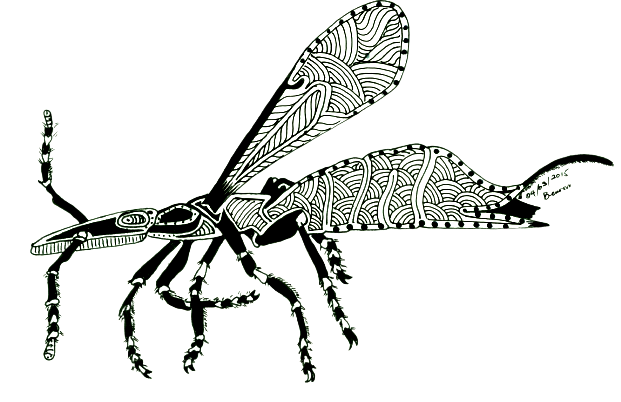
Artwork by Benson Avea.